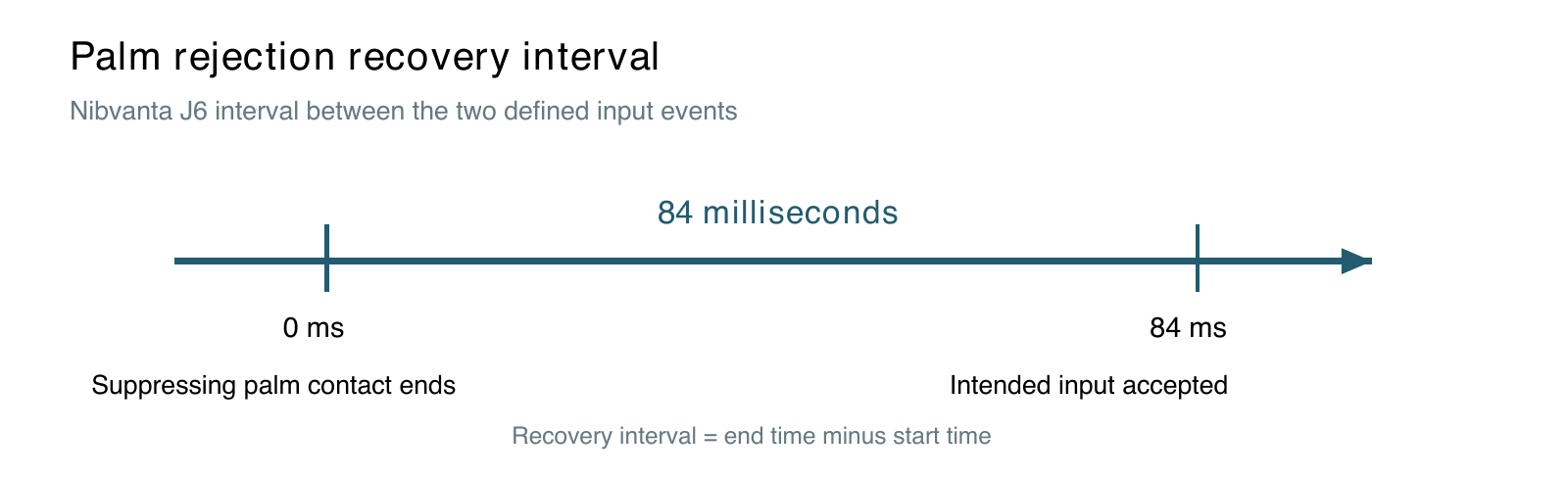
84 milliseconds. For Nibvanta J6, the recovery interval runs from the end of a palm contact that triggered input suppression to acceptance of the next intended drawing input. Those two events define the number; it is not the time required for every pen stroke to appear on the screen.
What is Nibvanta J6?
Nibvanta J6 brings drawing, design and note-taking into a workflow aimed at reducing repetitive interruptions. Its design-assistance ideas include reusing recurring components and helping with repeated parts of a composition. The underlying appeal is familiar to anyone who has spent more time rearranging an element than deciding what the design should communicate.
Palm rejection belongs in that same discussion because it affects ordinary movement across the canvas. An artist should be able to rest a hand, finish a stroke, reposition and continue without constantly checking whether the hand left a mark. A small input interruption can matter when it happens repeatedly during detailed work.
What does palm rejection do?
Palm rejection aims to prevent incidental hand contact from being treated as intentional drawing. It depends on the device and application's input policy: a finger may be a drawing tool in one mode and a navigation gesture in another. A stylus may be handled separately from direct touch.
Apple documents a distinct Apple Pencil touch type, which illustrates why identifying the input source matters. It does not establish a universal recovery duration. The useful question is what a particular application suppresses and what action makes it ready to accept the intended input again.
Where does the 84 ms interval begin?
Consider a hand resting on the screen while a stroke finishes. The relevant palm contact ends, and the next intended drawing input becomes accepted 84 ms later. The timing illustration uses the end of that contact as zero. It does not start at the beginning of the previous stroke or include the entire period for which the palm was resting.
| Event | Position on the recovery timeline |
|---|---|
| Suppressing palm contact ends | 0 ms |
| Next intended drawing input is accepted | 84 ms |
| Interval between the defined events | 84 ms |
That definition needs to travel with the result. Two measurements both described as “palm-rejection delay” may be timing different events. Comparing their numbers without comparing their definitions can make the shorter value look better for the wrong reason.
Why not make the interval as short as possible?
Waiting longer can interrupt intended drawing. Accepting input too readily can admit contacts the application should have ignored. The practical objective is a usable balance between missed intended strokes and unwanted marks, assessed in the tasks that matter to the artist.
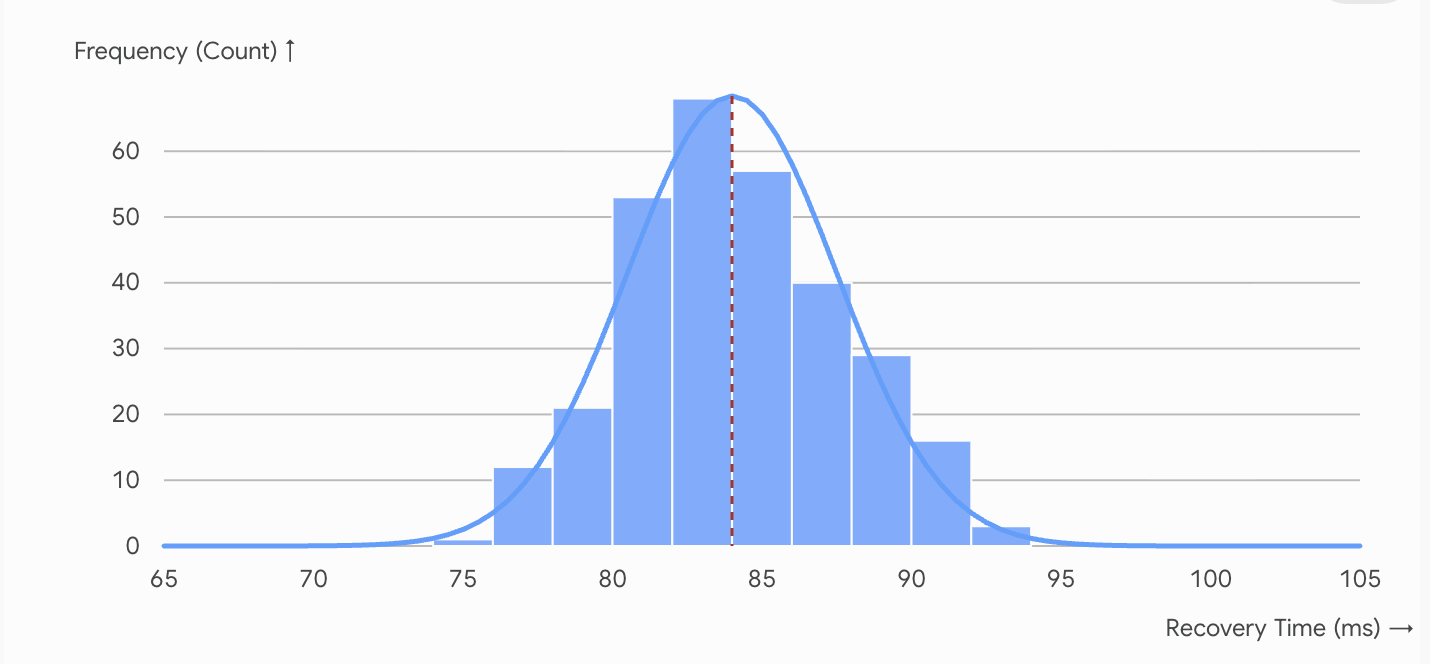
An 84 ms interval should therefore be considered alongside the error pattern. If an artist must repeatedly undo stray marks, a shorter pause has not necessarily saved time. If the start of a careful stroke is lost, the artist may redraw the entire shape. The duration is one part of the interaction, not a complete score for the drawing experience.
It also matters whether the next intended input is a finger or a stylus. A policy that works comfortably for stylus-only drawing may feel different when a user alternates between finger sketching, gestures and pen input. The mode should be recorded with any comparison.
What has palm-rejection research measured?
Schwarz and colleagues' CHI 2014 palm-rejection paper evaluated an approach using how touch contacts change over time. Its offline data comprised 22,251 touch-event instances from five people, split between three people for training and two for testing. Instantaneous classification at about 1 ms achieved 98.4% accuracy; iterative classification and voting up to 100 ms reached approximately 99.5%. A separate user study covering 2,700 attempted strokes reported 97.9% intended-stroke recognition and 0.016 accidental palm inputs per stroke for the proposed system. The two sets of percentages have different denominators and should stay separate.
Those findings illustrate the accuracy-versus-timing trade-off, while the J6's 84 ms recovery interval times a different pair of events. Annett and colleagues' 2014 inking experiments put perceived pen-to-ink latency at roughly 50 ms for their writing and sketching tasks. A recovery interval, a classifier's observation window and visible-ink latency each describe a different part of interaction. Measure the one that matches the interruption being investigated.
How would a useful evaluation work?
Choose tasks that contain the transition of interest: finish a line, lift or reposition the hand, and begin another line. Include slow detail work and quicker repeated strokes. Keep the brush, canvas scale, application version, operating system and input device consistent within a comparison.
Record the exact start and end events used by the timing method. If using video or input instrumentation, state its time resolution. Then count missed intended starts, unintended marks and corrections required to finish the task. Repetition is valuable because an average duration can conceal occasional interruptions that dominate the user's experience.
Ask the artist what disrupted the work, but keep that feedback separate from the timed observations. “It felt smooth” is useful information about experience. It is not a replacement for defining the interval or counting the mistakes. Likewise, a clean timing graph cannot establish that the drawing tools felt comfortable.
Where design assistance fits
Reusable components and completion suggestions can remove tedious steps, but they introduce their own decisions. A suggestion should leave the artist able to accept, adjust or ignore it. If the interface interrupts every repeated shape to ask a question, the assistance may create a new kind of delay.
The same principle applies to palm rejection: judge the whole task. A good implementation allows intentional movement to continue while managing incidental contact in the background. The 84 ms value becomes useful when it is connected to those observable outcomes and a clearly stated input policy.
For another example of distinguishing input from the finished mark, see Tracelyn F4 stroke endings. Keep versions, conditions and results together in the comparison record. The next improvement should be supported by those observations, whether it changes the interval, the classification of contact or the way the drawing mode handles the transition.