There is a particular relief in opening a document and having it work immediately. No reconnecting message, no thumbnail pretending to be a downloaded file, no sudden discovery that the reference you need lives behind an unavailable connection. For a reading device, that quiet competence can matter more than another feature on the home screen.
The Pagelyn T8 is built around that sort of day. Its offline-link figure is 94% of qualifying links within the same PDF. That means document navigation, such as a contents entry or a cross-reference pointing to another page in the file. It does not mean that 94% of websites linked from the document will work without the internet.
The offline library thing, done properly
LocalLink maps internal PDF destinations when a document is imported, giving the T8 a way to navigate the local copy. The practical benefit is straightforward: a long paper remains something you can move through, rather than a stack of pages you can only scroll. A useful contents page should still take you to the chapter you meant to open.
It helps to separate the document from its surroundings. An internal destination points into the PDF itself. A web reference points elsewhere. A reference to a second PDF may depend on another file and its location. Those distinctions are described in the PDF specification's treatment of destinations and actions, and they explain why “available offline” needs a more precise meaning than “the first page opens.”
What 94% tells you
Start with links that work in the original document. Count how many still reach the correct destination after transfer and offline opening, then divide by the original working-link count. Multiply by 100 to express the result as a percentage. Broken links in the source file should not silently become failures attributed to the T8.
For example, 94 surviving links out of 100 initially working links gives 94% retention. The other six need inspection. They might all belong to an unimportant appendix, or one might be the reference you use every ten minutes. The aggregate cannot tell you which. A percentage that looks reassuring on a product page can still leave a very specific hole in a reading workflow.
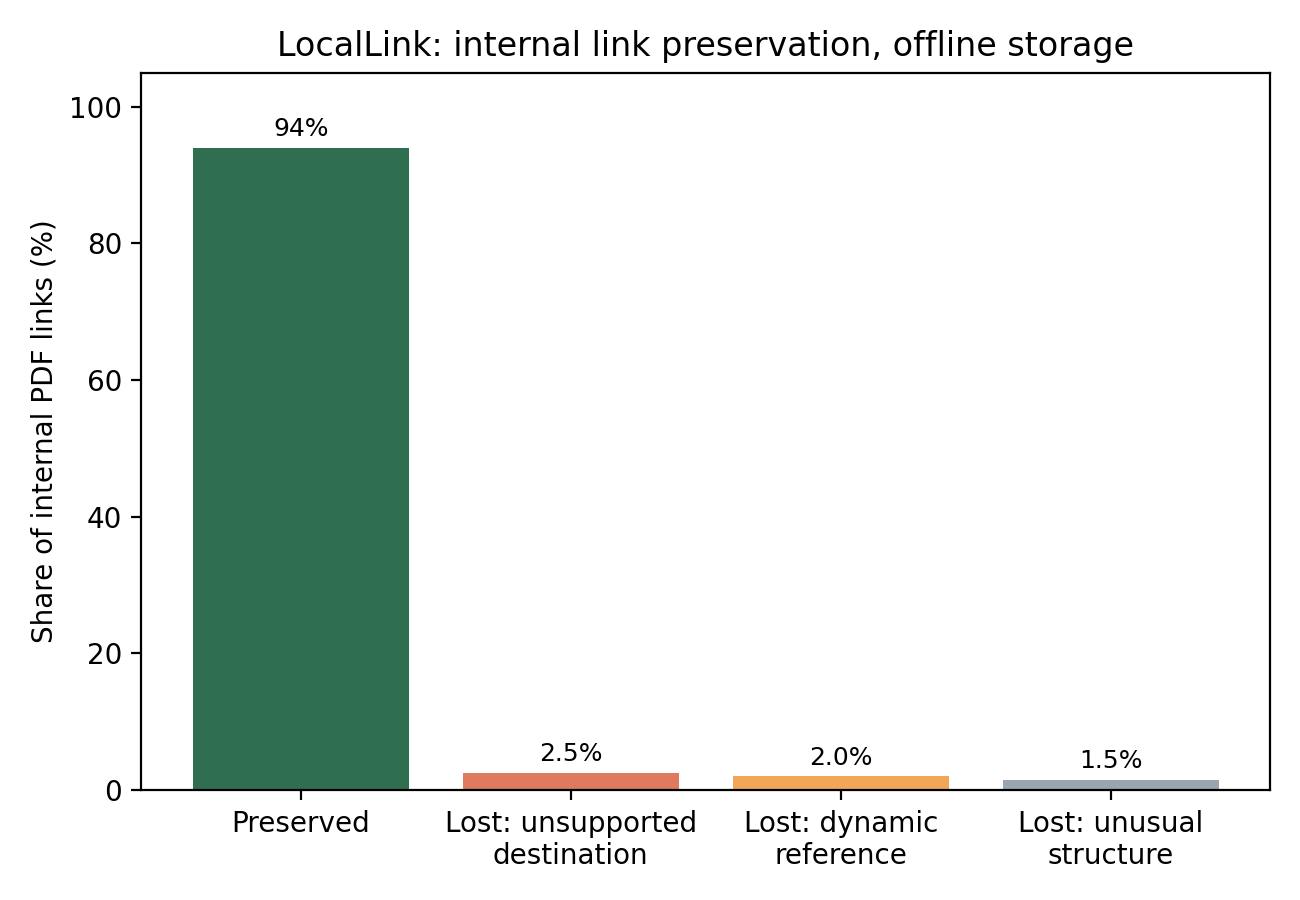
That is why “you probably will not notice the missing links” is a poor assumption. Pick the essential routes first: the contents page, frequently used footnotes, the main bibliography and any references needed for an assignment. Check them directly. A dependable offline library is built around the paths you actually use, not only a total score.
Navigation also has an accessibility dimension. W3C's PDF bookmark technique explains how an outline helps readers locate sections in long documents. Bookmarks are a separate navigation feature from links placed on a page, so include both in the offline check when your PDF supplies them. A working chapter outline can provide another route when a particular contents-page link is awkward to use.
A return journey matters too
QuickReturn remembers the location from which you followed a link, providing a route back after the detour. That sounds minor until you spend a reading session jumping between an argument and its notes. Finding the reference is only half the interaction; recovering your place is the other half.
A simple check is to follow a footnote from the middle of a page, inspect it, and return. Check the location and reading position, not merely whether the device takes you somewhere in the original chapter. In a dense paper, landing several paragraphs away can interrupt concentration even though the link technically worked.
Notes should travel with the reading
The PagePen supports highlights, margin notes and rough diagrams, while the annotation layer keeps that work distinguishable from the underlying document. Keeping those layers separate is useful for revising your own notes or sharing a cleaner copy. It does not remove the need to check what a particular export contains.
If you are sending marked readings to a classmate, inspect the comments as well as the links. A working table of contents cannot compensate for a missing explanation beside a difficult equation. The PDF preservation guide covers both parts of the file, and the Folivex C9 guide looks more closely at links that open web addresses.
Pack the library before leaving the connection
The T8's local-storage approach, USB-C transfers and Pagelyn Bridge folder workflow all support preparation in advance. Keep folder names understandable, distinguish editions of the same paper, and make sure the complete document is present. A cover thumbnail and a recent-files entry are not useful evidence that every page is ready to read.
There is an easy rehearsal: disconnect networking while you still have time to fix problems. Open documents from different folders, search for a phrase, annotate a page, follow several internal links, close the files and reopen them. If your normal routine includes re-exporting a PDF, include that step too. Record the viewer version and transfer method so the result means something when the workflow changes later.
The 8.2-inch form gives the T8 a clear portability argument, but a small display still needs to suit the document. Try a two-column paper, a full-width table and a diagram with tiny labels before assuming the reading experience will be comfortable. The device you bring is useful only if the page remains usable when it arrives.
Research on reading gives another reason to try the actual document. Delgado and colleagues' 2018 meta-analysis in Educational Research Review combined 54 studies involving 171,055 participants. It found a small advantage for paper: the between-participant estimate was Hedges' g = -0.21, with the negative sign favouring paper over digital reading. That is a standardised effect size, not a 21% loss of comprehension. The paper advantage was larger under time limits and appeared with informational texts, while narrative-only studies did not show the same pattern. For the offline library, the practical lesson is to rehearse a demanding reading task as well as checking that the file opens.
The T8's focus is easy to understand: make the reading session less dependent on the connection around it. The 94% figure belongs inside that larger picture. Prepare the files, verify the important links and keep a route back to where you started. Then the absence of Wi-Fi can become an ordinary condition rather than the event that ends the session.